
Welcome to our Summer 2026 Newsletter
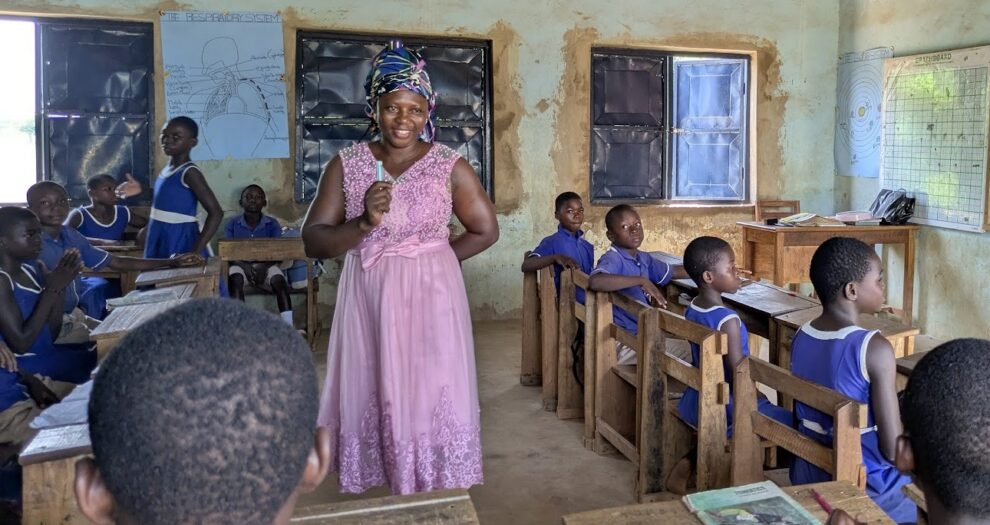
Savannah Education Trust is a charity providing an education for some of the poorest children in West Africa. We now have ten Christian schools in remote villages in northern Ghana: Bagri, Gberi, Korh, Pavuu, Mettoh, Tungan-Zagkpee, Boo, Baapari, Danko-Buree and Lyssah. The charity also ensures every schoolchild receives a meal each day and has a programme of supporting teachers in this remote and poor area.
Lawra Mourns
It is with great sadness that we report the death of Naa Puowelle Karbo III, Paramount Chief of Lawra Traditional Area, former President of the Upper West Regional House of Chiefs and past Vice President of the National House of Chiefs. He died on 21 April after a short illness. He was 79 years old.
 Our key partners in the work of bringing education to these remote communities are the church, the local community, the government – and the tribal leadership. The Paramount Chief was a wonderful friend of Savannah over many years. He was unremitting in his desire to bring education to the most remote and disadvantaged communities in his territory. He officially opened all but one of the “blue schools” – and the ceremonies were always marked by the Chief giving a powerful speech in English and Dagaare, accompanied by all the traditional pomp and ceremony of his office.
During the last audience of trustees with Naa Puowelle at Lawra Palace in March 2025 he stated that ‘the Savannah Education Trust coming here is the most important, developmentally significant event to have taken place in my Paramountcy. The impact on our society has been great. The approach by Savannah is so unique, relying on local participation and always stressing that the schools are built by the people for their children.’
Our thoughts and prayers are with the people of Lawra at this time of sadness and change. Our supporters will be interested to learn that the Regent, whose role is central to the transition of tribal leadership, is our former Country Manager, Pastor Charles Karbo.
Technical High School
Over the past few newsletters, we have mentioned the exciting possibility of a Technical High School for the Lawra district. This is now nearly a reality. A Technical High School offers vocational training to young people once they have completed their exams at age 14 (equivalent to a GCSE qualification in the UK). Without a Technical High School, options for further education are limited as mainstream schools focus on academic pathways whereas many of the children want to learn a practical trade which will enable them to start a small business to help their families. Without vocational skills, it is very challenging to secure stable employment or start a new enterprise. Many young people will either return to subsistence farming or migrate south to the cities in a desperate search for work.
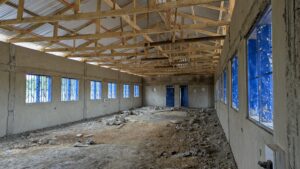
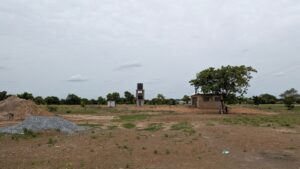
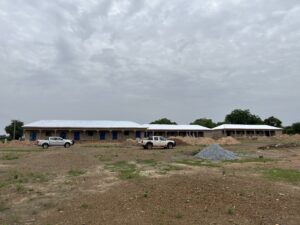
The Savannah team on the ground have become increasingly convinced of the need to provide vocational education to support these young people. After much prayer (seeking for both wisdom and the financial means to start the work), we were very thankful to receive initial funding to begin the Technical High School project. During a trustees’ visit in May 2026, it was a great thrill to be able to visit the site and see the new school rising from the grassland on the edge of the market town of Lawra.
Initially, we plan to start small – with textiles and dressmaking and masonry classes. The workshops and classrooms needed to teach these subjects are nearing completion, along with an administration block, water tower and electrical connection to the national grid. As with our existing schools, we plan to provide a meal for each student each day.
Because a Technical High School serves a much wider area than a local village school, it needs dormitory facilities in the second phase of the project. This will be a new venture for Savannah and comes with additional administrative and safeguarding complexities. We value your prayers for wisdom.
Close partnership with the Ghana Education Service is vital to our work. The Savannah team in Ghana are currently in consultation with the national government. There is an enthusiasm about the Technical High School, a recognition that the area desperately needs this type of facility and a willingness to take responsibility for running it, once the building is completed. This is another matter in which we ask you to join us in prayer – we seek wisdom as we communicate with government officials.
Savannah-Supported Teachers
One of the greatest challenges facing Savannah – and education systems worldwide – is the teacher recruitment crisis. Globally, an estimated 44 million new teachers will be needed by 2030, with around one-third (15 million) required in Sub-Saharan Africa alone to meet the demands of rapidly growing student populations.
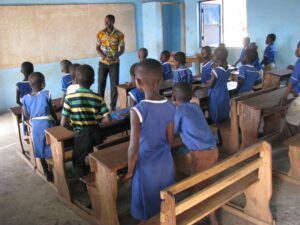
Savannah’s schools have brought education within the reach of thousands of children who would have otherwise never had the opportunity to go to school. But a school is only as effective as its teachers and, in the rural areas in which we work, attracting and retaining high-quality teachers is a particularly significant challenge. There are several reasons for this. Firstly, high adult illiteracy rates mean there is a limited pool of local people who can train as teachers.
Secondly, those who do gain teaching qualifications often move to more developed areas in the south, where opportunities and living conditions are better. Thirdly, the communities we serve are extremely remote, often lacking electricity, basic amenities and convenient transport links.
Savannah is addressing this challenge through a range of initiatives. Elsewhere in this newsletter we cover the provision of teacher accommodation in order to make working in our rural schools more attractive. Our teacher scholarship programme, running for over 20 years, funds training for teachers on the condition that they return to work in our schools. Today, around a quarter of our teachers have come through this programme. In addition, the new Savannah Teacher Training Centre in Lawra is being used to focus on improving the quality of teaching, and acting as an aid to teacher recruitment and retention.
Despite these efforts, teacher shortages remain a significant issue. To address this, Savannah has recently adopted a new approach: directly employing teachers. Previously, all teachers were recruited and paid by the Ghana Education Service. However, to ensure our schools are adequately staffed, we now also employ some teachers ourselves.
Currently, Savannah directly employs 38 teachers – around one-third of our total teaching workforce – at a cost of approximately £29,000 per year. This equates to around £760 per teacher annually. That is excellent value for Savannah, although tough for the teachers to live on – and also a new and ongoing financial commitment for the organisation at a time when funds are tight.
To fill these roles, we are drawing on a previously untapped pool of talent. In the past, many teachers in northern Ghana trained through distance learning programmes, which were particularly suited to those in remote areas. However, when the government withdrew recognition of these programmes, many qualified and experienced teachers were left without official posts. Savannah is now engaging these teachers to help meet the immediate needs of our schools.
In the long term, we hope that our existing programmes will reduce the need for direct employment. However, at present, these teachers are playing a vital role in ensuring that children in Savannah schools receive a quality education. Their contribution is making a meaningful difference, and this is only possible thanks to the continued generosity of our supporters.
Teachers’ Accommodation
Savannah’s schools have brought education within the reach of thousands of children who would have otherwise never had the opportunity to go to school. In the rural areas in which we work, attracting and retaining high-quality teachers is a significant challenge. One of the key ways in which we are trying to address this is through the provision of teachers’ accommodation at our most remote schools.
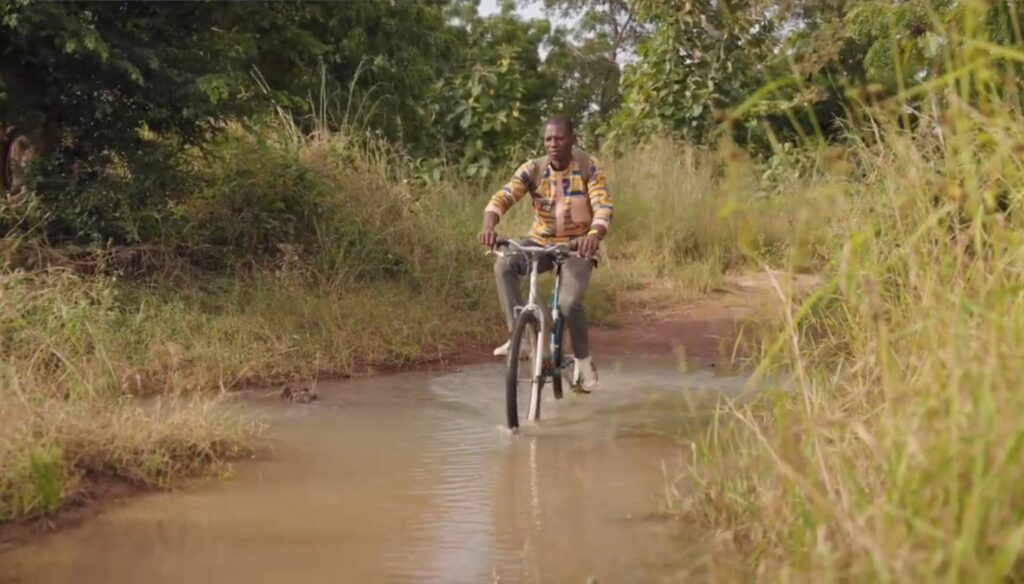
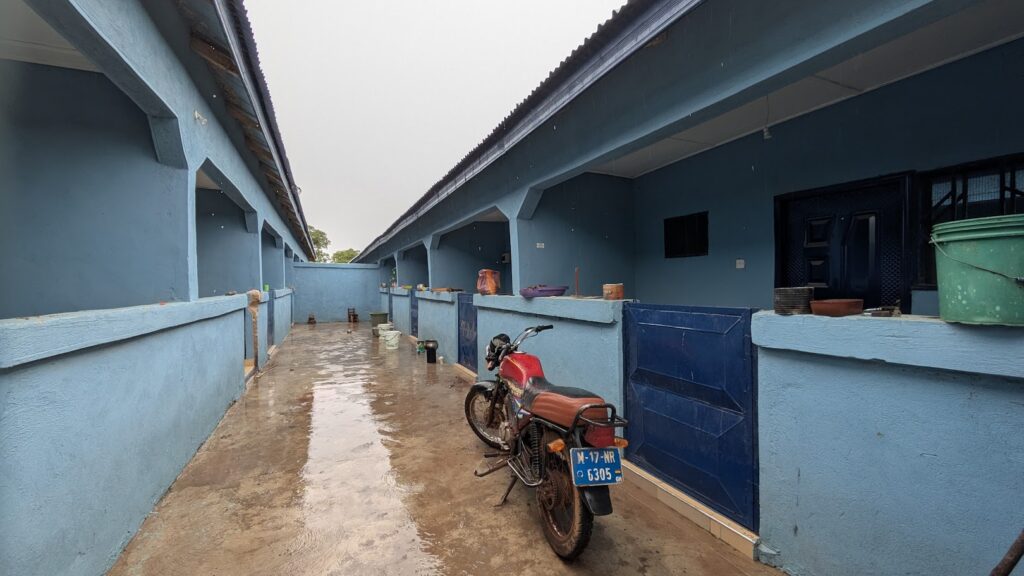
Thomas is a teacher at one of our Savannah schools. A local church member, he was delighted to receive support from Savannah to allow him to train as a teacher. He sees his role as a privilege and a calling – and teaches in one of our most remote schools. But it is difficult for him to get to school, especially when the weather is bad.
Africa more widely is facing a teacher recruitment crisis, and Savannah’s rural schools face the impact of this most keenly. The challenge is exacerbated by the fact that teachers in Ghana now have a large amount of choice over which regions they are sent to, and they are much more likely to choose developed, urban areas with easy access to amenities rather than rural villages with a lower standard of living, like those served by Savannah. Those, like Thomas, who do come to Savannah’s schools have to choose between poor quality housing in local villages, often without running water or electricity, or a long commute from Lawra, spending most of their salary on fuel. He is thrilled that we have been able to build good quality accommodation with adequate lighting and running water. For teachers like Thomas, it means we can overcome these challenges and incentivise teachers to come to our schools – while also helping to retain those who are already working there.
The impact of teachers’ accommodation was strikingly illustrated during our recent trustees visit, which took place at the beginning of the rainy season. One morning we set off to visit schools in the midst of a downpour, which lasted all morning. Even the Savannah team’s rugged pick-up trucks were sliding as the tracks turned to mud, never mind the motorbikes used by teachers travelling from Lawra. We arrived at Korh Primary School to find a group of eager children who had walked through the rain to school, but only one teacher, Boateng. He explained that all the other teachers lived far away from the school, and had found the roads impassable. He, on the other hand, lived in the new teachers’ accommodation next to the school, and so the rain had proved no issue. He told us that he was from the Asante region, in the south of Ghana, but had chosen to come to Korh because of the accommodation provided by Savannah. When we moved to the Korh Junior High School, we were happy to see lessons underway: three of the JHS teachers, we discovered, lived in the teachers’ accommodation. Their close proximity to the school ensured that teaching and learning could continue, whatever the weather.
The provision of teachers’ accommodation, then, enables Savannah to attract teachers to our most remote schools, and removes obstacles to children receiving a high-quality education. Teachers can also easily provide extra-curricular activities for the pupils, enhancing attainment and ensuring that sports and cultural activities don’t have to take time away from learning. We now have teachers’ accommodation at three schools – Bagri, Boo, and Korh – with a fourth soon to be finished at Baapaari. As the Lord provides, we hope to be able to expand this to more of our rural schools, helping to ensure that every child can receive a high-quality education.
Gold Rush
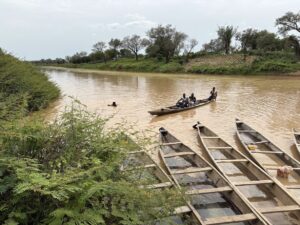 Supporters will be familiar with the iconic images of the Black Volta River – a lifeline for local communities, where families collect water, wash clothes, and fish. In recent years, however, the river has become increasingly polluted, threatening the subsistence way of life that depends on it. Less visible is the source of this contamination: formal and informal gold mines upstream in Burkina Faso. The gold rush is also affecting our students. Drawn by the promise of quick riches, some of our older boys are heading north to seek their fortunes. Some return home with substantial earnings, creating a harmful incentive for others to trade long-term health and education for modest short-term financial gain.’
‘Hope in the Savannah’ webinar
We often wish we could take supporters to see our work in Ghana: the sheer joy of the “blue schools” and the many happy children. The next best thing is film and we are grateful for support from a professional film maker to produce a documentary about our work.
We are excited that the inaugural screening of the Savannah documentary ‘Hope in the Savannah’ will take place via webinar at 7pm on Saturday 31 October 2026. This will be followed by a brief update on the work and the latest news on the Technical High School. We are hopeful that this timing will allow our supporters in the USA and Canada to join us. Those living locally are invited to join us at Westoning Baptist Church, where light refreshments will be served after the webinar. Log-in details will follow closer to the date.
Rising costs
A strengthening cedi (reducing the relative value of foreign currencies) and high inflation rate continue to create a difficult financial situation, especially as our work expands.
We therefore remain extremely grateful for, and entirely dependent on, your kind support. As we plan for the future, we continue to find regular direct debit contributions especially helpful. As ever, please feel free to be in contact if you would like to talk to us about any element of Savannah’s work, or you need advice on the practicalities of supporting the work (whether that is amending an existing direct debit, or discussing a legacy).
Above all, we remain thankful to the Lord who continues to supply all our needs.